
Adverse Childhood Experiences: How Early Children’s Mental Health Programs Support Healing and Resilience
"I adopted [my daughter] from the foster system. She's my world." Jenn Barlow reflects on what her daughter had been through by age three. "A few months ago, my husband told me that he had been molesting her. He's been in jail since that day. We're now divorced. [She] has lost another parent, and she has a lot going on in her little heart."
Access to early mental health intervention can transform a child’s life trajectory and restore hope to a family, as it did for Jenn Barlow. Once a client navigating her daughter's trauma, she is now a longtime board member and donor to The Children's Center Utah.
Exposure to high levels of toxic stress from Adverse Childhood Experiences (ACEs) — abuse, neglect, violence or household dysfunction — can disrupt healthy brain development, impacting a child's ability to regulate emotions, form secure attachments, and build trust. Barlow’s journey highlights the role that specialized children’s mental health programs play in guiding families through recovery. Counting a simple "ACE score" is never enough to understand a child's needs; true recovery requires comprehensive, specialized support. However, an ACE screening by an early childhood mental health specialist may be included as part of an initial evaluation.
What are adverse childhood experiences? The famous study that defined ACEs.
Malinda Freitag, CMHC, IECMH-E® works daily with children affected by ACEs. The licensed clinical mental health counselor specializes in infant and early childhood mental health and defines ACEs as specific categories of traumatic events.
“ACEs were originally defined in the '90s by researcher Dr. Felitti,” Freitag says of the CDC-Kaiser ACE Study that surveyed 17,421 adults about ACEs and famously proved the connection between the responses and participants’ current health records.
"It was groundbreaking because it found that the number of ACEs you had was correlated with a variety of outcomes, including medical outcomes. Adversity and trauma have an impact. And that impact is felt across social, behavioral, mental health, and physical medical outcomes."
The CDC-Kaiser ACE Study categorized 10 experiences into 3 groups of ACEs:
Abuse
- Physical Abuse
- Emotional Abuse
- Sexual Abuse
Neglect
- Physical Neglect
- Emotional Neglect
Household dysfunction
- Substance use in the home
- Mental illness in the home
- Parental separation or divorce
- A caregiver treated violently
- An incarcerated household member
Beyond these instances, other conditions in a child's environment may undermine their sense of safety, stability, and bonding. Food insecurity, unstable housing or homelessness, community violence, bullying, and discrimination also shape a young child's stress response.
What ACEs are not?
Adverse childhood experiences are not a diagnosis, nor do they necessarily mean trauma. “The ACE Study was designed as a retrospective epidemiological survey for adults and not as a comprehensive mental health screening tool for use with adults or children,” according to The National Child Traumatic Stress Network. “The ACE score approach does not capture the frequency, severity, duration, or developmental timing of exposure to such events, and excludes other common traumas and adversities.”
ACEs are not a prediction and not all are created equal. Some ACEs, or specific combinations of them, are more potent than others. A high score does not mean your child is destined for poor health or a hard life. It means the risk is higher, which is a very different statement. ACEs are not a judgment on your family. Divorce is on the list, so is a parent's mental illness. No parent can control these factors.
ACEs are not limited to one kind of household. Families who love their children will still accumulate ACEs, often through circumstances nobody chose.
Mental health care at The Children’s Center Utah
Infants, toddlers, preschoolers and their families and caregivers thrive in the care of The Children's Center Utah. Families find their way to us for a variety of reasons and every child receives a safe space to communicate their experiences so providers can identify the underlying issue.
“One kiddo I was working with had experienced pretty significant neglect,” Freitag says of a three-year-old in foster care. Many kids in foster care have experienced trauma, she says. Oftentimes, it's a traumatic experience—like parental substance use, neglect, or physical abuse—that brings them into the child welfare system. “When the child was brought into care [to us] through DCFS, there were concerns regarding growth, weight, nourishment, and cognitive development—including limited speech.”
Much of the work happened with the child's foster caregivers, helping them understand how the child's history of neglect was showing up in everyday behaviors, especially around food.
"You're not going to give a lot of limits or discipline related to food, because that's going to trigger more fear around it," Freitag says. "We found healthy ways to direct that, [and] help [the child] understand that it was there for them, that there were things they could have whenever they wanted." The progress was significant. "By the end of treatment, the child and family no longer struggled with food intake or hoarding, and the child was able to use words and simple sentences to communicate their needs, which was great progress for that child."
The Children's Center Utah is the only organization in Utah providing trauma-informed, evidence-based mental health treatment exclusively to infants, toddlers, preschoolers, and their families and caregivers since 1962. Services include outpatient clinical care, a therapeutic preschool program, psychological testing, and psychiatry.
“We focus on the relationship between the child and their caregiver and really help caregivers understand cues and needs and how to respond to the child,” says Jennifer Mitchell, VP of Clinical Strategy and Innovation at The Children’s Center Utah. “That sets them up to succeed with whatever hurdles or challenges they might experience later.”
What is an ACE score?
“At intake, all parents or caregivers complete a screening for possible trauma and adversity,” says Joni Clark, The Children’s Center Utah Development Director.
“These screeners support our clinicians in evaluating possible trauma experiences and symptoms for the child and family,” Freitag adds. “While not every child who has experienced adversity requires formal trauma treatment, these initial screeners help clinicians engage with families around trauma and appropriate treatment needs through more in-depth assessment and treatment planning.”
The questionnaire asks parents and caregivers yes-or-no questions about the child’s experiences and scores them from 0 to 10 by category. Because each category counts only once, the score overlooks duration, severity, age of occurrence, or supportive relationships. It also omits protective factors, particularly a stable, responsive relationship with a caring adult.
Here at The Children’s Center Utah, we never use an ACE score to judge or define a child. Instead, it serves as a gentle, supportive starting point to help our caring team understand your child's journey and how we can best wrap our arms around your family.
How ACEs have a lasting impact
A child's stress response is supposed to turn on and then turn off. A loud noise, a scary dog, or a parent leaving the room triggers an increased heart rate and stress hormones are released. Then a caregiver shows up, and the system settles. That cycle teaches children the world is manageable.
Toxic stress happens when the system stays switched on. When adversity is severe or ongoing and no consistent adult buffers it, stress hormones stay elevated for long stretches during the years the brain is being built. That prolonged activation affects brain architecture, the immune system, and the body's stress-response systems, which can later show up as difficulty with attention, decision-making, learning, and emotional regulation (Source: National Library of Medicine).
This is why ACEs are a physical health issue as much as a mental health one. The original study found a graded relationship between the number of ACEs a person reported and their risk for serious health problems decades later.
Why ages 0 to 6 matter most
The brain develops faster in the first five years than at any other point in life, and it builds in response to its environment (Source: Harvard). A brain shaped by unpredictability learns to stay on alert. That adaptation is intelligent in the short term and expensive over a lifetime.
Young children are also the least equipped to tell anyone what is happening. A ten-year-old can say they are scared, while a two-year-old cannot. The indicator is behavior instead.
The brain most vulnerable to early adversity is also the most responsive to early intervention (Source: Harvard). Treatment at three works differently than treatment at thirteen.
What parents and caregivers of young children might notice
Distress tends to show up in the body and in behavior first, because young children cannot narrate what happened to them,
- Sleep and feeding. New resistance at bedtime, night waking, nightmares, appetite changes, refusing foods they used to eat.
- Regression. Losing skills they already had. Toilet training slipping, speech going backward, needing help with things they were doing independently a month ago.
- Big reactions. Meltdowns that seem out of proportion to what caused them, and that take a long time to come down from.
- Clinginess or withdrawal. Either extreme. A child who will not let you out of sight, or a child who has gone quiet and stopped seeking you out.
- Difficulty being soothed. Soothing strategies that once worked no longer do.
- Hypervigilance. Startling easily, scanning the room, reacting to noises or transitions that never used to register.
- Aggression. Hitting, biting or throwing, often at daycare or preschool rather than at home.
All of these also happen in typical development. A four-year-old can be challenging at bedtime for entirely ordinary reasons. What matters is change, duration, and intensity: something shifted, it hasn't shifted back, and it is interfering with your child's daily life or yours.
“He was about two years old, and to be honest, I bawled my eyes out the day I dropped him off,” says one mother about coming to The Children’s Center Utah. “I thought I would never see him again. I thought I was losing my baby. It turned out to be the best thing that ever happened. Now, we have so much understanding and hope.”
What to look for in a mental health treatment for a young child
Not every trauma program is built for young children, and a program's quality is not always visible from its website. At The Children's Center Utah, we offer evidence-based treatments for children from birth through age six, as well as their parents and caregivers. Here’s what to look for:
- Age-appropriate care: Programs built for teenagers don't transfer to toddlers. Look for programs geared specifically to your child’s age. At The Children’s Center Utah, our evidence-based, trauma-informed programs serve children under six.
- Evidence-based modalities: Ask which treatments they use and what the research behind them shows.
- The caregiver is part of the treatment: Parents and caregivers are pivotal to successful mental health treatment for young children and should always be included.
- Purposeful Screening: Ask what screening they do, who reviews it, and what happens next.
- Trauma-informed: The entire environment, not just in the therapy room, should be trauma-informed. This includes any staff your family may interact with, including waiting room personnel, office workers, and those involved in treatment.
- Financial circumstances are not a barrier: Ask about sliding scale, Medicaid, and financial assistance.
- Coordination across all care settings: This includes preschool, childcare, and primary care physician.
Questions to ask a provider
When looking for the best-fit mental health treatment, ask your care provider these questions.
- Do you treat children my child's age?
- How many children under six do you see?
- What kind of therapy do you use, and what does the research say about it for kids this young?
- Will I be part of the treatment, or do you work with my child alone?
- What does screening look like here, and what happens after?
- What will the first few visits actually feel like for my child?
- What if we can't afford this?
- Will you talk to my child's preschool or primary care physician if I want you to?
You are not alone in this. According to the National Survey of Children's Health, more than one in six Utah children (17.6%) ages 0‒17 have experienced two or more of the following ACEs: economic hardship; parental divorce or separation; living with someone who had a substance use disorder; being a victim or witness to neighborhood violence; living with someone who had a mental illness, had serious thoughts of suicide, or was severely depressed; being a witness to domestic violence; having a parent serve jail time; being treated or judged unfairly due to race/ethnicity; or experiencing the death of a parent (data based on a two-year estimate).
At The Children’s Center Utah, we’re in this together. See how we can help.
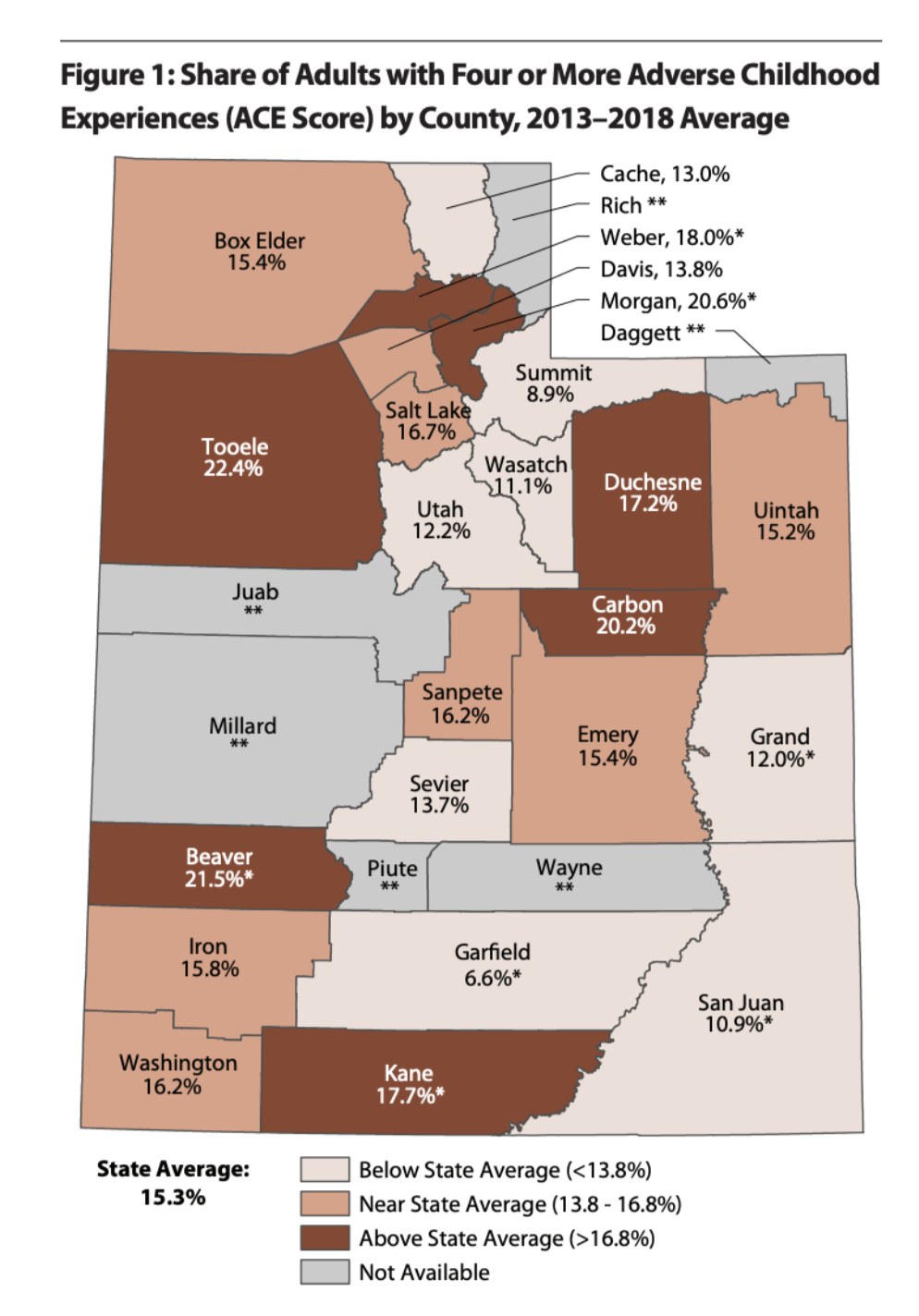
Credit: Kem C. Gardner Institute